



How to Write a Research Question: Types, Examples & Step-by-Step Guide
A well-crafted research question is the backbone of any successful academic project. Whether you're writing a thesis, dissertation, or course paper, your research question determines everything—from your methodology to your conclusions. Yet many students struggle to move from a broad topic to a focused, answerable question. This guide walks you through everything you need to know about developing research questions that will set your project up for success.
By

Joe Pacal, MSc
Search literature guides
TL;DR
Your research question defines what you're investigating and guides your entire study. Good research questions are clear, focused, complex enough to require research, and answerable with available methods. The three main types are descriptive (what), relational (how things connect), and causal (why). Start broad, narrow through literature review, and refine until your question is specific and feasible.
What Is a Research Question?
A research question is the central inquiry your study aims to answer. Unlike a topic (which is broad) or a thesis statement (which makes a claim), a research question poses a specific question that your research will explore. It serves as a compass, keeping your investigation focused and your arguments relevant.
According to the Purdue Online Writing Lab, your research question should emerge from reviewing existing literature and identifying gaps or unresolved debates in your field.
Example of the difference:
Topic: Climate change and agriculture
Research question: How do rising temperatures affect wheat yields in the American Midwest?
Thesis statement: Rising temperatures have reduced wheat yields in the American Midwest by an average of 6% per decade since 1980.
Why Research Questions Matter
Your research question directly impacts:
Scope and focus: It prevents your project from becoming too broad or unfocused
Methodology: Different question types require different research approaches
Literature review direction: It tells you what existing research to examine
Data collection: It determines what evidence you need to gather
Evaluation criteria: It provides a standard for measuring whether your research succeeded
A weak research question often leads to months of wasted effort. A strong one can transform an overwhelming project into a manageable, meaningful investigation.
The 3 Main Types of Research Questions
Understanding these categories helps you choose the right approach for your study:
1. Descriptive Questions (What?)
These questions seek to describe a phenomenon, population, or situation. They're often the starting point for research in emerging areas.
Characteristics:
Focus on identifying, documenting, or characterizing
Often used in exploratory research
Common in qualitative studies but also appear in quantitative surveys
Examples of descriptive research questions:
What are the primary coping strategies used by first-generation college students?
What factors do hiring managers consider when evaluating entry-level candidates?
What are the main themes in patient feedback about telehealth services?
2. Relational/Correlational Questions (How are things connected?)
These questions examine relationships between two or more variables without implying that one causes the other.
Characteristics:
Investigate associations, patterns, or correlations
Cannot establish causation—only connection
Common in quantitative research using surveys or existing datasets
Examples of correlational research questions:
Is there a relationship between social media usage and academic performance among high school students?
How does employee job satisfaction correlate with workplace absenteeism?
What is the relationship between sleep duration and standardized test scores?
3. Causal Questions (Why? / What effect?)
These questions investigate whether one variable causes changes in another. They require more rigorous methodology to establish causation.
Characteristics:
Seek to establish cause-and-effect relationships
Typically require experimental or quasi-experimental designs
Include independent and dependent variables
Examples of causal research questions:
Does implementing a four-day workweek reduce employee burnout?
How does early literacy intervention affect reading comprehension in third grade?
What is the effect of mindfulness training on anxiety levels in graduate students?
Research Question vs. Hypothesis: What's the Difference?
Many students confuse research questions with hypotheses, but they serve different purposes:
Research Question | Hypothesis |
|---|---|
Asks what you want to find out | States what you expect to find |
Open-ended inquiry | Testable prediction |
Guides the study design | Can be supported or refuted by data |
Used in both qualitative and quantitative research | Primarily used in quantitative research |
Example pair:
Research question: How does exercise frequency affect stress levels in working adults?
Hypothesis: Adults who exercise three or more times per week will report lower stress levels than adults who exercise once per week or less.
In quantitative research, you typically start with a research question and then develop a hypothesis that predicts the answer. Qualitative research often uses only research questions, as the goal is exploration rather than prediction.
Qualitative vs. Quantitative Research Questions
The type of research you're conducting shapes how you frame your question:
Qualitative Research Questions
Qualitative research explores experiences, meanings, and perspectives. Questions often begin with "how" or "what" and seek depth over breadth.
Examples of qualitative research questions:
How do nurses experience moral distress in end-of-life care situations?
What meaning do participants assign to their recovery journey from substance use disorder?
How do first-year teachers describe the challenges of classroom management?
Characteristics:
Open-ended and exploratory
Focus on understanding processes, experiences, or meanings
Often use words like "explore," "describe," "understand," or "experience"
Quantitative Research Questions
Quantitative research measures variables and tests relationships. Questions often seek to establish connections, compare groups, or measure effects.
Examples of quantitative research questions:
What is the average time to degree completion for part-time versus full-time MBA students?
Is there a significant difference in patient satisfaction scores between hospitals with and without patient navigators?
To what extent does parental involvement predict academic achievement in middle school?
Characteristics:
Specific and measurable
Include defined variables
Often include words like "relationship," "difference," "effect," or "compare"
How to Develop a Strong Research Question: Step-by-Step
Follow this process to move from a broad interest to a focused, researchable question:
Step 1: Choose a Broad Topic
Start with a general area that interests you or aligns with your course requirements. At this stage, don't worry about being too specific.
Example starting point: Mental health in the workplace
Step 2: Conduct Preliminary Research
Review existing literature to understand what's already known and identify gaps. Look for:
Unanswered questions in discussion sections
Suggestions for future research
Debates or contradictions among scholars
Populations or contexts that haven't been studied
According to the University of North Carolina Writing Center, a thorough literature review helps you identify where your contribution fits within the existing conversation.
Step 3: Narrow Your Focus
Use the "funnel" approach—move from general to specific by adding constraints:
Specify a population (who?)
Define a context (where?)
Set a time frame (when?)
Identify variables (what factors?)
Example narrowing:
Mental health in the workplace
→ Mental health support for remote workers
→ The relationship between employer mental health benefits and job retention among remote workers in the tech industry
Step 4: Draft Your Question
Write out your question in full. Make sure it's a genuine question (ends with a question mark) and not a statement or topic.
Step 5: Evaluate and Refine
Test your question against these criteria:
The FINER Framework:
Feasible: Can you realistically answer this with available time, resources, and methods?
Interesting: Does it matter to you, your field, or society?
Novel: Does it add something new to existing knowledge?
Ethical: Can you investigate this without harming participants?
Relevant: Does it connect to current debates or practical needs?
Step 6: Get Feedback
Share your question with advisors, peers, or writing center consultants. Fresh perspectives often reveal ambiguities or scope issues.
Research Question Template
Use this fill-in-the-blank structure to draft your question:
For descriptive questions: What are the [characteristics/factors/experiences] of [population] in [context]?
For correlational questions: What is the relationship between [variable 1] and [variable 2] among [population]?
For causal questions: What is the effect of [independent variable] on [dependent variable] in [population/context]?
For comparative questions: How does [group 1] compare to [group 2] in terms of [variable] when [condition]?
Common Research Question Mistakes to Avoid
Too broad: "How does technology affect education?" → Better: "How does tablet use in kindergarten classrooms affect phonemic awareness development?"
Too narrow: "How many students at Jefferson High School used ChatGPT for their November 2024 history essays?" → Better: "How do high school students describe their decision-making process when choosing to use AI writing tools?"
Not actually a question: "The impact of social media on teenagers." → Better: "How does daily Instagram use relate to body image satisfaction among teenage girls?"
Leading or biased: "Why is standardized testing harmful to students?" → Better: "What are the perceived effects of standardized testing on student motivation?"
Unanswerable: "What is the best economic system?" → Better: "How do GDP growth rates compare between market economies and mixed economies over the past 30 years?"
Discipline-Specific Examples
Social Work Research Questions
How do social workers navigate ethical dilemmas when client self-determination conflicts with safety concerns?
What is the relationship between case manager continuity and housing stability for chronically homeless individuals?
How do foster youth describe the transition to independent living?
Historical Research Questions
How did women's labor force participation during World War II reshape domestic gender roles in the postwar period?
What factors contributed to the decline of the Hanseatic League in the late 15th century?
How did enslaved people in the antebellum South preserve and adapt West African cultural practices?
Psychology Research Questions
What is the effect of cognitive behavioral therapy on insomnia severity in adults with comorbid depression?
How do attachment styles predict relationship satisfaction in long-distance couples?
What are the lived experiences of adults diagnosed with ADHD after age 40?
How AI Tools Can Help Generate Research Questions
Modern AI-powered research tools can accelerate the question-development process. By analyzing existing literature, these tools help identify gaps, suggest angles you might not have considered, and show how your topic connects to the broader scholarly conversation.
For instance, when you enter a broad topic into an AI research workspace, it can surface related themes, show you how existing studies have framed similar questions, and highlight under-explored areas—giving you a springboard for developing your own original research question.
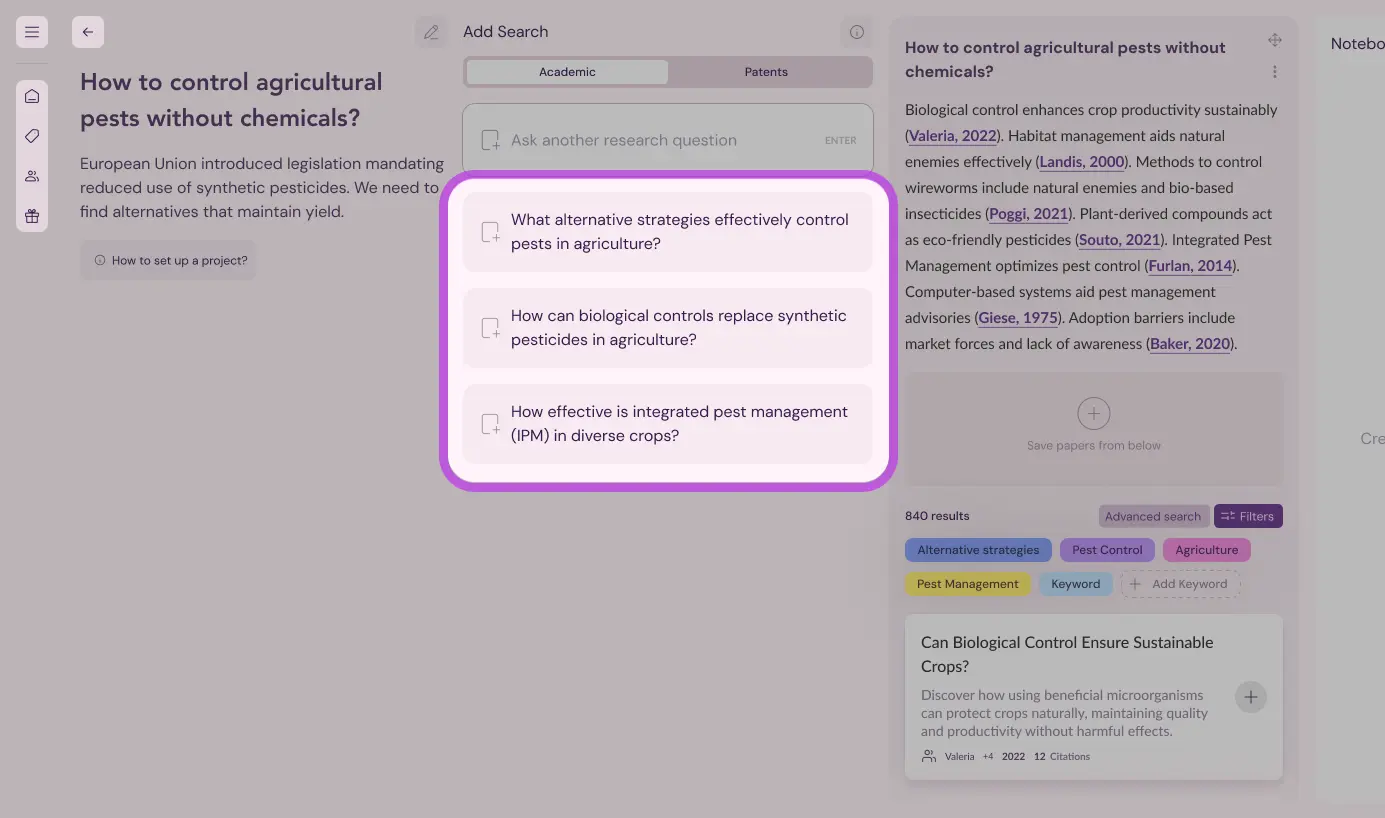
Try finding your research question in Wonders.
The key is using AI as a brainstorming partner rather than a replacement for your own critical thinking. The best research questions emerge from the intersection of what interests you, what the literature reveals, and what's feasible to investigate.
References
Purdue Online Writing Lab. "Writing a Literature Review." https://owl.purdue.edu/owl/research_and_citation/conducting_research/writing_a_literature_review.html
University of North Carolina Writing Center. "Literature Reviews." https://writingcenter.unc.edu/tips-and-tools/literature-reviews/
University of Queensland. "How to Write a Literature Review." https://my.uq.edu.au/information-and-services/student-support/study-skills/assignment-writing/how-write-literature-review/literature-review-example-analysis
Frequently asked questions
More literature guides

Complete Guide to AI-Assisted Research Ethics
Explore the correct use of AI in academic research.

Step-by-Step Guide to Organizing Academic Literature
How to collect, categorize, and analyze your literature review.

How to Find Research Gaps: 3-step-method
Learn a simple, 3-step, method to find research gaps.